Showing posts with label Central Otago. Show all posts

Wednesday, September 5, 2012

Kiwis and Coffee

Imagine a land of immense natural beauty and wide-open spaces, where farming is still a common occupation and gumboots are common attire in restaurants. As the work day comes to a close, men and women with strong, calloused hands, dust in their hair, and dirt-stained clothes meet up to unwind over a hot drink.

Now imagine that hot drink is a cappuccino.

Does that make sense?

Not to me.

New Zealand has a robust coffee culture and of course, plenty of Kiwis aren't farmers. But this country has an odd cross-section of coffee drinkers that is one of the weirdest things about it. North Americans are well-known for their disregard for "real" coffee - we like it watery and drink it by the gallon as we walk, or more likely drive, to work. Coffee is fuel. In Europe, it's almost the opposite - they drink it sitting down or not at all, and always in reasonable quantities. Coffee is an event.

Kiwis fall in between the two. Espresso-style coffee is the norm here, and most people know the difference between the various drinks, the most common being a flat white (known as café au lait outside the Antipodes). Most coffee companies offer barista training, and that can be a highly skilled position. In Wellington particularly, getting a job as a barista is difficult without a year's experience.

Outside of New Zealand's few large population centers, the espresso machine still dominates coffee. In the farming region of Central Otago, a local café owner made me a coffee as tasty as any I had in Wellington (but I'd go back for the pancakes). The café that I work in at the moment is beside a state highway, and plenty of truckers order large takeaway espresso coffees, usually with a couple sugars. In New Zealand that makes sense, but in North America that sounds like a bizarre joke.

But the people who really intrigue me are the older Kiwis, many of whom probably remember a time before espresso coffee took over. Most of them have learned to navigate through all the Italian words on the menu and figure out what they actually want, but the ones who don't stand out. Like the man who ordered a "flat white cappuccino," a drink that doesn't exist, and said, "I only wanted one," when I brought him a flat white and a cappuccino. Or the woman who asked for "a coffee," and when I asked her to clarify, she talked about how she used to get it out of a packet. And, just today, the woman who asked for a latté, and when I asked if she wanted sugar, replied, "Yes, sugar and milk too, please."

It seems to me that most of our customers just want espresso and hot milk in a cup. Perhaps that's why being a barista is, in practice, not as abhorrent as I thought it would be - there are very few coffee snobs in Arthur's Pass. But with my North American perspective, it's frustrating to watch people who would be perfectly happy with "a cup of joe" feel obligated to order something more complex. Especially since, for most drinks, after grinding the beans, running the shot, and steaming and pouring the milk, all you've added is air. 

A flat white with a fern drawn into the milk. Bonus points for presentation.
Basic intro to espresso coffees - we don't make espresso con panna or café breve.

Wednesday, January 18, 2012

Not the Beach Boys' West Coast

Finding a job to follow apricot-picking was quite easy, as I mentioned in my previous post. Getting there, however, promised to be an adventure in itself. Arthur's Pass is a village of less than 100 people on the eastern side of the mountain pass for which it is named, well within the boundary of the national park of the same name. And I would be approaching it via the West Coast, one of the wildest areas of New Zealand, without my own transport.


Despite the formidable journey ahead of me, I spent one day in Alexandra tying up loose ends. Without really thinking about it, I was making the third major move of my time here; despite staying in a variety of places, I had been in Central Otago for almost two months. As I packed my bag, I remembered why I enjoy having a job to keep me in one place – my pack is gigantic, and its contents don't like to stay put. I don't mean it's bursting, but if I stay in one place for more than two nights, necessity will empty at least half of it and spread it throughout my living area. So as I packed to leave Alexandra, I could look forward to being able to empty the bag again in two days.

The bus connections to Arthur's Pass were, predictably, not the smoothest. Central Otago is not on a well-worn tourist track, and the West Coast's massive size and winding highways make it difficult to pass through quickly. Rather than try to make an inadequate bus schedule fit my needs, I decided to hitchhike all the way if I had to. I gave myself two full days, and it all began outside Alexandra at around 8.45 on Tuesday morning. After about 15 minutes, I was picked up by two women working for a franchise of Crest Cleaners on their way to Cromwell. It wasn't quite the distance I was hoping for, but putting Alexandra behind me was good enough.

After almost no time waiting in Cromwell, I was collected by a couple from Edmonton who are also on working holidays. They both worked north of town, and were able to drop me at a spot about 20 kilometers outside Cromwell. As I waited next to a sheep pasture and listened to their bleating in the intervals between passing cars, the movie O Brother, Where Art Thou? came into my head, as it tends to do. I remembered the scene where the main characters pull over to pick up Tommy in the middle of a vast stretch of farmland. Despite the racial inaccuracy, the line that kept popping into my head was, “Pull over, Everett, let's give that colored boy a lift,” Southern drawl and all.

It was not a long wait, however, and before long I was riding next to a blinds salesman on his way to Wanaka. He clearly made the drive frequently, as he was talking on his phone as he picked me up, and was quite willing to find ways to distract himself while driving, including looking up Arthur's Pass village on Google maps. Although he was good company, I was glad he was only going as far as Wanaka. That stretch of road is not particularly tricky to drive, but it would have been a nightmare riding with him through the Haast Pass.

After being dropped at the turnoff for the West Coast to join about four other hitchhikers in the same spot, I was soon picked up by a Danish pilot on a two-month holiday. He was heading through the Haast Pass in a rental car, and we got along very well. Far from being in a rush, he was taking full advantage of being on such a scenic route. We made three stops for photos, some of which required small hikes, and he was even generous enough to provide me with lunch. I would have happily ridden with him to Jackson Bay (literally the end of the road, southwest of Haast), but I felt obligated to continue north and so began hitching again in Haast.

Haast was...well, it barely was. It's actually a group of three settlements that are all several kilometers apart, and from where I hitched I could only see a roadside café, a gas station, and a regional tourist office. But maybe my opinion of it was worsened by the wait I endured there. Haast is either the last or the first town on the West Coast highway, and it seems that few tourists make time to stop there. The Fox and Franz Josef glaciers are well to the north, and Queenstown and Wanaka are all the way over the mountains to the southeast. Many people seemed reluctant to even slow down as they passed. Very few of the cars that passed me were driven by young tourists like myself; most were rented camper vans, which I have found to be disinclined to picking up hitchhikers, as they are often occupied by families. So I waited. The time passed fairly quickly, as each car could have been the one to stop, and one hour passed almost without my noticing it. I also knew my Danish friend would be headed north later in the evening, so a ride would come eventually. But I was thrilled when one of the campers finally stopped, a rental driven by a middle-aged English couple. They took the time to provide me with a seat belt in the rear portion of the vehicle, and said they were heading to Franz Josef, the further of the two glaciers.

Once again, I was lucky to be riding with a cautious driver for an extremely difficult stretch of road. The West Coast is filled with one-lane bridges, hairpin turns, and winding ascents and descents. I had been thinking of hitching even further that evening, but as we passed mile after mile of uninhabited scenery, I began to think further progress unlikely. There is almost nothing in the way of human settlement between Haast and Fox Glacier, about 100 kilometers apart. I began to worry that I might not be able to find a place to sleep, but once we reached Fox Glacier, I knew I was back in tourist country. Fox and Franz Josef are two towns that exist solely because of glacier tourism, and every building seems to provide either accommodation, food, or tours (some have all three). When I arrived in Franz Josef, I had my pick of at least ten different places to stay, which must be a record for a town of its size.

After such a long day of hitchhiking, and thinking that I should probably get to Arthur's Pass fairly early in the day, I reexamined the bus schedules and found that hitching would not be necessary. Although tickets were not cheap, I had saved money the previous day and felt the need to be fairly exact about my arrival time; I was heading to a new job, after all. So I made the necessary purchases (about 10 minutes before departure) and soon found myself cruising towards Hokitika. We made a very entertaining stop at the Bushman's Centre in Pukekura, a welcome reminder that quirkiness exists in even the smallest towns. And the small town of Hokitika, of which I had high expectations for some reason, left a very favorable impression on me. I couldn't stay to find out why, however, as I was quickly headed off to Greymouth and then inland to the mountains. Within three hours, I was in Arthur's Pass and getting acquainted with my new surroundings. 


Lake Hawea.
At the Blue Pools in Mt. Aspiring National Park.
Thunder Creek Falls, also in Mt. Aspiring National Park.
Outside Haast, where I waited almost two hours.
A small portion of the Bushman's Centre's character.


Me and one Pukekura's locals.

The Otira gorge, just below Arthur's Pass.

Sunday, January 15, 2012

After the Gold Rush

After the events of my previous post, I returned to Alexandra to begin a job as a cherry picker. Since then, things have been fairly uncertain, so I figured I would wait for some concrete developments before posting anything (a lifetime of supporting the Boston Red Sox has taught me not to tempt fate).


I had originally not planned to do any farm work during January, as Kiwi students on summer holidays would make competition for jobs even steeper. But during my time thinning apples in Roxburgh, I heard about the "red gold" that is Central Otago's cherries (oddly enough, an area with a history of gold mining). So I lined up a job in Alexandra and showed up for my first day on January 4. About one hour into the day, I was asked to pick apricots instead of cherries. Happy just to have a job, I accepted. But there's a reason they don't refer to apricots as "orange gold."

Apricot harvesting is more difficult than cherry harvesting, as you carry more weight at a time and receive less money per bag. Pickers are guaranteed more work because apricots are hardier than cherries, but the work is much more intense than thinning was. While thinning, I was generally left alone to work and received two or three visits per day from my supervisors. Picking requires everybody to work in the same area so as to fill bins (about 30 bags' worth of apricots) more quickly, and the supervisor is an almost constant presence. Harvesting is more time-sensitive than thinning, and the pressure to get the job done quickly passes all the way down from the orchard managers to the pickers. Pickers, being the bottom rung of the ladder, hear constant complaints about the color, size, and firmness of the fruit they pick. And even if every bag is perfect, there will be good fruit left on the trees that must be removed, and of course, constant pressure to earn minimum wage (if you're not earning minimum, the orchard is forced to top up your pay and gets fewer apricots from you). I found earning minimum very challenging, meaning I did not feel very secure in my position. It was also discouraging to watch a group of 20 pickers dwindle to about 8 in less than a week. When I realized how far I'd wavered from my original plan for the month of January (not only was I doing farm work, I wasn't even doing the farm work I'd hoped to do), I decided to move on.

Luckily, right when that occurred to me, Central Otago received its first serious rain since I've been here (late November). That gave me two days off to plan, and a quick job search found a café in Arthur's Pass looking for a general kitchen hand. In a reminder of why I love New Zealand so much, I sent off a fairly speculative job application, which got me a reply by phone within an hour. Within two hours of sending the application via email, I had a new job.

Arthur's Pass is a small village on the train route between Greymouth and Christchurch, in the heart of the Southern Alps. The train that passes through it is considered one of the most beautiful train rides in the world, and tourism continues throughout the year (the scenery is better in the winter). Although this job will prevent me from seeing Southland during the summer, it will hopefully allow me some stability over the next few months. As I need to renew my passport, having a consistent address will be useful. And as much as I enjoy the simplicity and exercise of seasonal farm work, I've had much better experiences working in cafés.

Spending 9 hours per day picking apricots doesn't leave much time for photography. But a couple coworkers and I found a creative way to release the stress and frustration of hearing "too green!" every time we dropped a new bag. See below.


Wednesday, January 4, 2012

Surviving the Holidays


Despite spending three of the past five years overseas (give or take a few months), I have always made it home for Christmas. Not so this year. New Zealand is simply too far and thus, too costly to return from for such a short visit. So for the first time, I faced every traveller's greatest challenge – I was on my own for the holidays. The idea had scared me a bit in previous years, and I would not have done it if not for the distance, but I can happily report that things worked out rather well.

Once I had arrived in Wanaka, I set about making plans to stay occupied on Christmas Day, when all the shops would be closed. As I was expecting to be alone, I decided to embrace it and do that most solitary of activities: fishing. Wanaka is a popular fishing area, and it was easy to rent a rod and buy a 24-hour license on Christmas Eve. Saving those for the next day, I spent that evening in the Cinema Paradiso, which is unique enough to merit an entry in the Lonely Planet guidebook to New Zealand. Every film is presented with an intermission, at which there are freshly made cookies for sale. The theatre seating is varied, with couches, standard cinema seats, and an antique car all squeezed in front of the screen. The film selection seems to be mostly second-run features, and every day's schedule is completely different. I was caught between Midnight in Paris and The Guard, but feeling that a bit of a distraction might not be a bad thing given my situation, I bought tickets to both (there was a free cookie in the bargain).

On Christmas itself, I spent about two hours walking to a recommended fishing spot. As it turned out, it was along a walking trail, and Christmas is a lively day for outdoor activities here. I don't think I ever went 30 minutes without someone passing by and asking how the fishing was. Unfortunately, it was not a lively day for the fish, and I only managed one bite, after which a large, smug trout jumped about three feet above the surface. It was nice to be reminded that there were fish in the river at all, but my day's tally was unbalanced, with no fish taken out and two rented lures left in. I bought fish and chips to account for the freshly caught trout that I wasn't eating, and went to bed satisfied that I'd filled up what could have been a long, lonely day.

With Christmas behind me, I hitchhiked back down to Alexandra and settled in for the start of my cherry-picking job. It was only at 6 AM on my first day that I learned my first day had been moved back a week. It seemed I would be stuck waiting in Alexandra over New Year's, but coincidence worked in my favour. One of my pub quiz teammates from Wellington happens to be from Dunedin, and also happens to have a family cottage not far from Alexandra. We also happened to be close to one of the biggest New Year's parties in New Zealand, about an hour away in Queenstown. So on the last day of 2011, I found myself enjoying a beautiful ride along the Kawarau Gorge, on my way to the “adventure capital of the world.”

Queenstown is Wanaka's older, more extroverted brother. It draws huge amounts of tourists for a variety of reasons: its beautiful location; its skiing in the winter; and its bungee jumping, skydiving, and parachuting in the summer. Needless to say, it was packed for New Year's Eve. The campsite is allowed to expand to the rugby field in the center of town to handle the overflow of visitors. Many of them were young Kiwis from the surrounding area, but a few were international travellers such as myself. Our tents were pitched next to those of some young men from Saskatchewan, of all places. We spent our afternoon hiking up Ben Lomond to get one of Queenstown's most famous views (and a bit of a workout). Although it was busy at the top, my aversion to crowds did not spoil the scenery. Back at the campsite, we tossed a football around with the Saskatchewan boys before joining up with some other friends from Wellington to ring in 2012. Despite the crowds, there was no trouble, and the fireworks display was fantastic. We rode back to Alexandra on New Year's Day, tired but satisfied with our brief excursion.
In the end, the holidays were fairly easy to handle on my own. It is important to point out, however, that the holidays in New Zealand feel nothing like those I'm used to. I still have not adjusted to the complete reversal of the seasons down here, and I only knew it was Christmas because stores kept posting their holiday hours. While North American Christmas happens just as winter is really setting in, Kiwi Christmas happens just as summer is heating up. That makes Christmas back home a bit of a relief from the snow and the cold, something to look forward to during the year's shortest days. Here, my mood had already been lifted by the heat and the sunshine, and the Christmas decorations in store windows just confused me. New Year's was the same – the weather made me think of Independence Day or Canada Day, not New Year's. The time difference between here and home also reinforced the oddity. For the first 18 hours of 2012, my family was still in 2011!

One of the seats in the Cinema Paradiso.

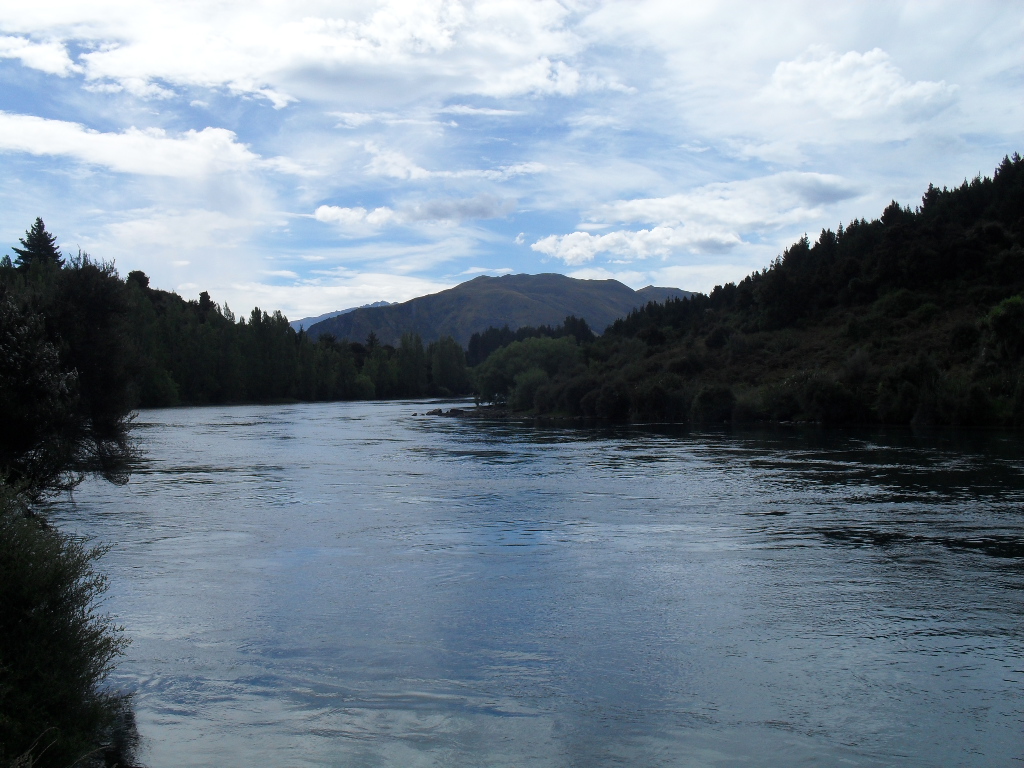
The Clutha river, near where I went fishing.

Looking down at Queenstown from Ben Lomond.

Parachuters over Lake Wakatipu.

A small part of the tent city on the rugby field.

Friday, December 23, 2011

6,063 words (or its equivalent in photos)

My job thinning apples finished on Thursday, and now I'm spending Christmas weekend in Wanaka, a little resort town north of Queenstown. It remains to be seen what I'll be doing next, but it will probably involve harvesting cherries somewhere in Central Otago.

I feel as though I've been relying too much on verbal descriptions lately, so here's 6,000 words worth of photos.

Waiting for the bus to work at 7.30 in the morning.

My last row of apple trees to thin (on the left).

The view from the top of the ladder.

Wanaka.

Lake Wanaka.

The only snow I'll see this Christmas.

Thursday, December 15, 2011

Peon's Progress


Rain has kept me out of the orchard for the second time this week, so I thought a general update on life in Roxburgh might be in order. Apple thinning is going well. Although we get paid by the tree and I do not move particularly quickly, we are guaranteed minimum wage and we work plenty of hours per week, so I've made a tidy sum already. The first week was a challenge, but since then my body has adjusted to the schedule. Seasonal work has a reputation for being physically demanding, but apple thinning has to be among the least so. You're not required to carry anything apart from the ladder, and your speed depends more on hand-eye coordination and dexterity than on muscle strength. I was skeptical about my fitness for the first few days, but now I'm planning to stay in Central Otago through January for the cherry harvest, which is apparently quite lucrative.

Apart from the massive quantity of working holidaymakers I've met here, there is a group of workers from Vanuatu who come here annually for the same reason. Much like Caribbean workers in Niagara's vineyards, these guys have specific seasonal work visas that allow them to work from November to April. They work an exhausting schedule, but they joined in a big game of soccer last Sunday (everybody's day off). It was fun listening to them talk, as their language mixes in intelligible pieces of English, Spanish, and French. When they asked for a substitute, they would say something like, “Wanagum? Wanagumplay?” I also heard quite a few double syllables, a trait that Pacific languages seem to share (Maōri does it too). The sound “bilim bilim” came up frequently, though I'm not sure what it means. It was a nice treat to interact with them, because we working holidaymakers speak of the “Vanuatus” as the standard for excellence in seasonal labor. They work from 7-5:30 for 6 days, and rumors of their speed are always making their way around the hostel. Naturally this means we have little chance to talk with them, since they're always working, cooking, or sleeping – unless it's Sunday.

My current job ends next week, so the Christmas holidays will play host to my next little adventure – Wanaka. I had numerous ideas about my first Christmas away from my family, but Wanaka comes well-recommended from my coworkers. It's not as touristy or as busy as Queenstown, but it is gaining a reputation for its New Year's festivities. I'll be staying there for a while, but there's plenty to do in Wanaka – it's on the shores of Lake Wanaka, close to Mount Aspiring National Park, and developing a range of high-adrenaline activities in the shadow of New Zealand's adventure capital, Queenstown. This will also be my first time in the Southern Alps, the mountain range that runs the length of the South Island. Limiting myself to Wanaka rather than visiting Southland (my other idea) will also allow me to get back to Central Otago fairly quickly after the holidays, increasing my chances of landing a job harvesting cherries. 

Downtown Roxburgh. Don't blink.

Playing the gee-tar down by the Clutha river.


Saturday, December 3, 2011

Workin' in the Fields 'til you get your back burned, workin' in the fields 'til you get your facts learned...


With one week of apple thinning behind me, many of my questions about seasonal work have been answered. And I can confidently say that this foray into farm labor has not been a mistake. I found a job almost by accident on my first day of searching in Alexandra, and began work the next day in Roxburgh. The ease of finding full-time work is one major benefit of seasonal employment – hospitality jobs in Wellington were almost always for part-time or casual employees.

I began working within 24 hours of finding the job, after moving from Alexandra to Roxburgh and settling in for an early wakeup the next morning. We spent the first morning filling out pre-employment forms and signing a contract, then began thinning under the supervision of our foreman, a very friendly and understanding guy. Most of my coworkers are internationals like me, with a few Kiwi students there for the summer (I'm still getting used to December being the summer). The largest groups seem to be Germans, Czechs, and South Americans – primarily Argentinian, with a few Uruguayans and Chileans in the mix. The first thing our foreman said was, “how is everybody's English?”

Since then, it has been 40 hours of the most repetitive work I've ever done. Thinning simply means reducing the fruit on the trees to allow the remaining apples to grow to full size. It is amazing how many discussions can be had about various thinning techniques, but none of them seems to eliminate the problem of sore thumbs. Much like the callouses built by playing guitar, however, the thumbs eventually toughen up and now I hardly notice as I thin 60 small trees per day. My coworkers spend much of the day with headphones on, but I prefer to let my mind wander, which can hardly be avoided when doing such mundane work.

Once I overcame the initial hurdles of changing my routine and building a thumb callous, I've come to my own set of conclusions about seasonal farm work. Many people arrive with illusions of working hard and making tons of money, but the prices per tree are designed so that workers make minimum wage. My biggest frustration has been the lack of transparency about the prices, which is such that I may have done 50 trees before learning their price. I even worked a full day unaware that the price of the trees I was thinning had dropped because we were working too quickly. However, the law guarantees us minimum wage every day, and the long hours mean I will certainly be able to save some money no matter how fast I am (they also ensure that I have little energy to spend money elsewhere). I had also been concerned about the intensity of the job, something everyone mentions. It's lucky I'm doing thinning rather than harvesting, as it requires no lifting. While certainly physical labor, I return from work in a gratified state of fatigue, rather than in serious pain. Sleeping has never been so easy.

There's one more hurdle I've had to overcome – being surrounded by fellow travellers. Although I spent plenty of time with foreigners in Wellington, many of them were English speakers, and I spent at least 50% of my time with Kiwis. Seasonal farm labor, logically, seems to attract non-native speakers of English, as it doesn't require them to speak it. It has been quite a change to be in the minority as a native speaker of English, and to hear New Zealand spoken of as a place to visit rather than as a place to live. In the end, of course, I am just a visitor, but I've always preferred to live abroad, rather than just be abroad. I can dream, can't I?

This job lasts for another three weeks, and I'm still formulating plans for Christmas and New Year's. More than likely, they will not involve being anywhere with a tree and presents, and certainly not with snow. Regrettably, I have not taken any photos of my new job, but I can promise you, it looks much better than the inside of an office.

Thursday, December 1, 2011

The Edinburgh of the South


This now week-long journey on the South Island was always meant to end in Central Otago for the fruit harvest, where I am now. I did remain in Dunedin for a few days, however, and it had plenty to offer. The presence of the University of Otago means Dunedin bears some resemblance to Kingston, ON (where I went to university) – many of the houses in the downtown area are undeniably student houses, and most cafés provide wireless internet for free. But while Kingston gets overshadowed by Ottawa and Toronto, Dunedin is one of the major cities in New Zealand and thus feels less exclusively like a university town. When I stopped by the tourist office to pick up a map, it was full to bursting with cruise ship passengers and Elton John fans (he performed on Friday). And although I did stop by the university, it was less a destination than a place to wander.

One thing I definitely wanted to see in Dunedin was the Speight's brewery. Being in a country so far from all others, most of the beer here is uniquely Kiwi, but Speight's is probably the most likely to be recognized overseas thanks to its long-running Southern Man ad campaign (for Neil Young fans, that's someone from southern New Zealand, not the U.S.). Being such an iconic brand – and such a tasty beer – I almost felt obligated to take the tour. The Speight's brewery is one of the few remaining gravity-operated breweries in the world, meaning its raw materials are delivered to the top floor and the finished product comes out at the bottom. They also still use wooden vats in the fermentation process, the only remaining brewery in the world to do so. Their location was chosen based on the presence of a spring, which not only makes the beer but is also diverted to a tap on the street and made available to the public. But of course the best part of any brewery tour is the tasting. Although Speight's limits its guests to 30 minutes, they do allow you to pour your own (in fact, they require you to), and they play the Southern Man ad campaign as you do so. If I was designing a brewery tour, I could hardly do better than they have – I believe I owe the folks at Speight's a “good on ya, mate.”

As I wandered around Dunedin, Central Otago was always in the back of my mind. I made sure to buy a new pair of shoes for outdoor work, as well as a rain cover for my pack. I haven't done any farm work yet, but I do know one thing – trying to plan for it in advance is immensely frustrating. Everybody I've spoken to has given me contradictory advice, and potential employers do not seem to hire in advance (for fairly logical reasons). I had long since decided that the solution was simply to be physically present in a region with jobs available, and I was right. I left Dunedin on Sunday afternoon and checked in at Alexandra Backpackers, which was luckily having its cherry season kickoff barbecue as I arrived. I heard even more conflicting reports from other travellers – some had work already, but the general consensus was that because the cherry harvest hasn't yet begun, jobs are hard to come by. Expecting a bit of a wait to find work in Alexandra, I made my way to a seasonal work agency this morning to hopefully make some sense of the situation. Typically of my experience with this job hunt, I was led to believe that there were very few jobs available, and that not having my own transportation would make it much more difficult to find work. I was ready to return to the hostel and settle in for a long stay when I was informed of a job opportunity in Roxburgh, just down the highway. I suppose it makes sense that such a frustrating job search would end so unexpectedly, but at least now I'm employed. And despite the confusion, I have once again managed to turn a vague shadow of a plan into reality, as I did in Wellington. The other foot has yet to drop in New Zealand. 

From the top of Baldwin St, steepest in the world.

In the Speight's brewery.

The tap from Speight's spring - free to everyone.

The Clutha River in Alexandra, where I stayed my first night in Central Otago.

Wednesday, November 9, 2011

The End of The Beginning

As I have written previously, I tend to write less the longer I stay in one place. That's the only excuse I can offer for the gap between this post and my last. Especially with the end of the World Cup, things have started to become fairly routine here, within a broad definition.

In my view, major sporting tournaments are more fun at the beginning than at the end. There's still so much to come, and surprises can happen at any time. Furthermore, there are so many games being played that a boring game doesn't remain long in the memory. As the tournament progresses and the games become more pivotal, the remaining teams inevitably sacrifice creativity for reliability. Thus we get tight and suspenseful, but objectively unexciting play.

All this is to say that my excitement over the World Cup waned a little in the knockout stages, which began immediately after my last post. With games only on weekends, rugby had a much smaller presence in my life. That's not to say I didn't enjoy the quarterfinal weekend, which saw Wellington packed beyond belief with supporters and players from South Africa, Australia, Ireland, and Wales. Nor is it to say that France's 9-8 semifinal win over Wales didn't drive me absolutely insane with frustration. But the All Blacks' win over France in the final was, for me, more depressing for what it ended than exciting for what it achieved. It didn't help that the amount of pressure heaped on the men in black meant the win was more a source of relief than of ecstasy for Kiwis - although anyone on Wellington's Courtenay Place after the game finished might disagree.  

So now the opening act of my time in New Zealand is coming to a close, as I plan to pack up and move down to the South Island. The weeks since the close of the World Cup have been a bit of a blur - there have been a few pub quiz victories, my flatmates' final recitals (clarinet and viola), and a busy and entertaining work schedule. You can expect more frequent posting from me in the near future, as I'm heading to central Otago for the cherry harvest and should find plenty of new and exciting things to write about. But for now, here's a few photos of the past five weeks.
In the Te Kopahou reserve.

A sea lion, right along the waterfront.

People lining up for the All Blacks' victory parade. I had to work.

Genius advertising.

In Island Bay...summer's coming!