Showing posts with label wildlife. Show all posts

Thursday, June 20, 2013

Going Out in Style


My parents once told me that if I ended up spending two years in New Zealand, they would try to come visit. New Zealand has become another home to me, and considering that it's not a place one can easily visit from North America, I was happy to give Mom and Dad a reason to make the trip. After a couple weeks spent zipping around the North Island and catching up with friends in Wellington, I flew to Christchurch to meet my parents after their trans-Pacific flight odyssey.

We only had two weeks to spend in the country together, unfortunately, so planning an itinerary was challenging. A number of compromises had to be made, especially as Dad was limited by some pretty serious sciatica aggravated by hours spent sitting in airplanes. Having just finished a meditative solo trip around the North Island, I had to adjust quickly to travelling not just as a group, but as a family. It had been just under a year since I'd even seen my parents, and now I was partly their tour guide as well as their son. And that's not to mention that I was still in the process of moving two years' worth of belongings back to North America. I had spent the previous year establishing a comfort zone in Arthur's Pass, and now I was emphatically out of it. With all that being said (or written), our trip went fantastically.

After meeting up in Christchurch airport and “uplifting” our rental car, we made a quick stop for some lunch and I drove us up to Arthur's Pass in the rain. We spent three nights there. I did my best to tie up loose ends while showing Mom and Dad around and introducing them to the people who shaped my time in the mountains. Mom, who hikes frequently back in Northern Ontario, quickly made the adjustment to hiking in the Southern Alps. Dad's sciatica kept him off the trails, but he learned more about local history in three days than I had in a year (thanks to John Charles).

We could have easily spent more time in Arthur's Pass, but our time was limited and there was more to see. So on Monday (Mom's birthday), I left the village that had been my home for the last time. We stopped in Greymouth to go to the post office, then in Hokitika to do some gift shopping, and then at the TreetopsWalk just south of Hokitika. I had hoped for another stop at the Bushmans Centre in Pukekura – my last chance at a possum pie! - but, being the low season, it was already closed. We ended that drive in Franz Josef, where we spent two nights. In addition to hiking, we arranged some more involved medical care for Dad in Fox Glacier and had medicine delivered via InterCity bus that would suffice for the rest of the trip.

After Franz Josef, we drove to Haast, where I had my last sight of the Tasman Sea, and then through the Haast Pass to Wanaka. It's easy to like Wanaka, and Mom and Dad certainly did. I made sure to go to Cinema Paradiso one more time – Dad and I watched The Company You Keep, but the film isn't really what matters when you go to Cinema Paradiso. It's the cookies. Mom kept hiking, and I took off on my own to walk up Isthmus Peak, on the isthmus between Lakes Wanaka and Hawea. It was a greater challenge than I thought, but well worth the views.

Our next destination was Lake Tekapo, the one spot on our journey that I had not visited. The drive over Lindis Pass was beautiful, but MacKenzie Country was the real stunner. After stopping in Omarama for lunch, we drove through Twizel and made a stop at the southern end of Lake Pukaki. It was a clear day, and Mt. Cook was visible at the other end. After tearing ourselves away from the great view, we continued on to Lake Tekapo. I've said it before and it's still true: New Zealand keeps finding new ways to amaze me. The scenery along that whole stretch of road was jaw-droppingly gorgeous. We spent two nights in Tekapo, taking tons of photos, marvelling at how the view across the lake was just as good by the light of the moon, and hiking up Mt. John.

Our longest drive on the South Island was between Tekapo and Kaikoura. We took the “inland scenic route” along highway 72 to Darfield, which was still mostly farmland, and made an afternoon stop in Christchurch. The red zone cordon had recently been reduced downtown, so I had my first sight of Christchurch Cathedral. I also introduced Mom and Dad to the Re:Start Mall, which was buzzing with activity. But we had to move on to Kaikoura, and stayed there two nights. After visiting the seal colony, Mom and I walked the Kaikoura Peninsula track and met up with Dad for a picnic in South Bay. We also spent some time arranging the logistics for the rest of our trip, as we were to return the rental car to Picton.

On the drive up to Picton, we stopped at the Ohau Point seal colony. Have I mentioned how New Zealand keeps finding new ways to amaze me? Like something out of an animated children's movie, we walked up a small stream from the ocean to a waterfall, at the bottom of which was a pool teeming with seal pups. Inland from the coastal seal colony, it was essentially a “seal daycare” where the parents leave their pups while they go fishing. Dad took a video (see below). There are no words to accurately describe it – simply one of the coolest things I've ever seen.

Our ferry from Picton was delayed by rough weather on the Cook Strait, but it was sunny in Picton. I made one last visit to the Village Bakkerij with Dad, then we all enjoyed the view of the waterfront while waiting for the boat to arrive. This strait crossing was my fourth, and the roughest one yet. I spent it lying down with my hat over my eyes to spare myself the sight of waves crashing over the side and other passengers losing their lunches. That kept me shipshape, and my biggest complaint was actually that we didn't get to arrive in Wellington in daylight.

We spent three nights in Wellington being tourists, dining out, and catching up with friends. On our last day there, Mom and Dad made their own bus tour of the city using the transit network while I did the last of my packing. Then we had a Wellington evening that could have been straight out of the Lonely Planet guidebook: dinner at KK Malaysian, a theatre production at Downstage Theatre, and gelato from Kaffee Eis for dessert. I hope it wasn't my last time in Wellington, but at least that was a great way to finish if it was.

As renting a car was the cheapest way for us to get to Auckland (we left it too late to buy plane tickets), we spent our last full day in New Zealand on the road. It's a long drive, but we have a family history that includes plenty of those. And I was thrilled that Mom and Dad were able to see some of the North Island too. We followed SH1 from Wellington to Auckland through Taupo, and although we bypassed Hamilton, it was almost exactly the same route I followed on the bus my first day in the country. After finding our hotel near the airport, I spent my last night in the country watching rugby at the pub downstairs. Again, if that was my last time in New Zealand – and I hope it wasn't – it's not a bad way to go out. 


Dad walking in the treetops.

Saying goodbye to the Tasman Sea at Haast Beach.

Lake Hawea from Isthmus Peak.

That's Mt. Cook on the left.

At Lake Tekapo.
Lake Tekapo.

Christchurch Cathedral.

Mom and I at Ohau Point seal colony.


Ohau Point. See video below...


Ruapehu.

Dad and I at Lake Taupo.

Tuesday, November 20, 2012

Practice Makes Photos

My situation in Arthur's Pass is, I dare say, pretty unique. Having begun my time here as a temporary worker, it's always been simpler for me to socialize with other working holidaymakers. However, I've now been here 10 months. When the locals started to realize that I wasn't running off just yet - and most of them began by asking "how long are you here for?" - social opportunities began to open up on that front as well. 10 months is the longest I've spent in any one place since I left university, and by January, I will have stayed here longer than any one place since I finished high school. Naturally, I'm a bit rusty at settling in and becoming part of a community, even if it's only for a little over a year. But I've been practicing, and everything seems to lead to something else.

Back when I first moved here, I mentioned that despite my love for the outdoors, I do not consider myself much of an outdoorsman. Apart from day hikes, most outdoor activities require expensive equipment, transportation, or training that I don't have. The good news is that I'm now surrounded by people who DO have those things. For instance, I think I am now better friends with hunters than I have ever been. I haven't yet taken up any offers to go out and fire a gun myself, but I have always had a fondness for eating wild meat, even before this year's Wild Foods Festival. So I recently came into possession of a goat's forequarter and turned it into stew, curry, and stock. Despite no butchering skills and a few ingredient hiccups, I had good reviews. (Thanks for the goat, Dave)


I've also been making more of an effort to get myself out walking the tracks around the village and further afield when I can. My work schedule had been hectic for much of September and October (by my own choice), and needing to take a 1.5-hour bus ride to buy groceries means weekends are not just free time. So opportunities to wander and discover are limited to one full day per week and the time before and after work. I recently managed to take my first swim of the season. As I dried off, I looked up to see the snow-capped mountain that fed the river I'd just been in. Not too shabby for an after-work dip. 

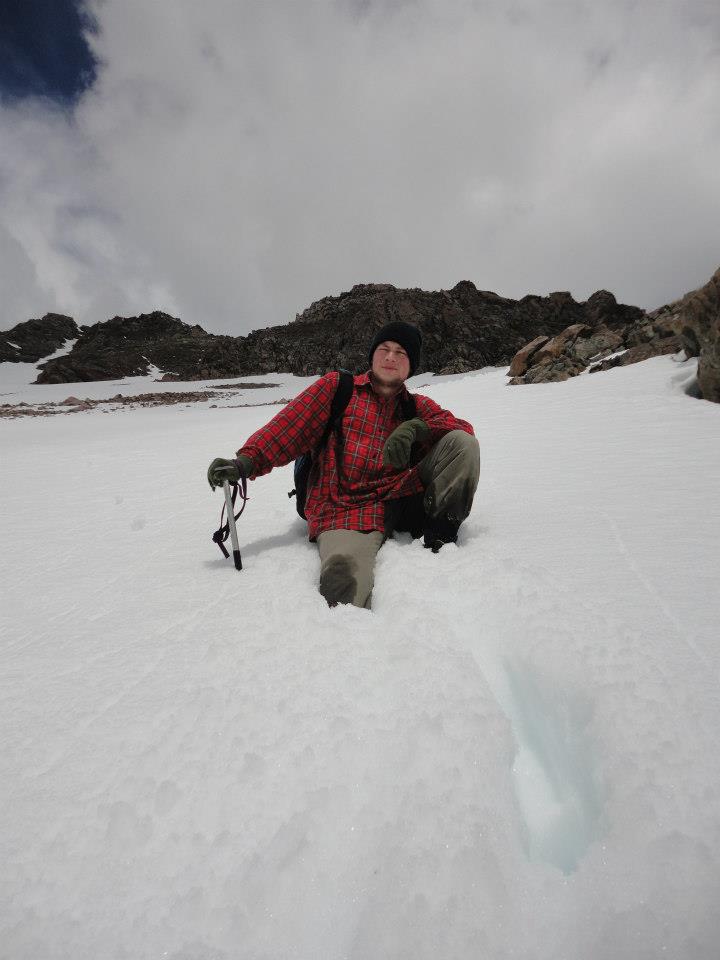
I also recently had the opportunity to learn how to use an ice axe for the first time in my life. Having grown up near the comparatively gentle Appalachian mountains, ice axes and crampons have always been for more ambitious hikers than myself. Up here, they're useful to have for almost any hike longer than a day. So last week, my flatmate Emily and I walked up to the local ski field with someone who knew what he was doing - thanks Geoff - and spent a day learning to self-arrest in the snow. We also spent some time bouldering and just generally used the ski area as our playground. There are videos of this, but here's a few of Emily's photos to tide you over.

Bouldering - the scenery here lends itself to dramatic photos.

Somehow, the first thing I saw in this photo was my neck beard.

Laying in the sun to dry off after ice axe practice...and getting sunburnt in the process.


This week's adventure was to the top of Avalanche Peak, which I climbed once before in January. This time there was snow on the track, but the view was still worth it. And this time, I was able to get photos with me in them (thanks Emily). 

Me looking at Mt. Rolleston, the peak I call "the postcard."

Look who showed up in time for lunch!


And as if all this wasn't enough, I have also been putting my brain to use writing quizzes for one of the two local pubs. Participation has grown every week and I'm enjoying the challenge of writing questions that are interesting but not impossible for a largely Kiwi audience. (From what I've heard, I may be guilty of keeping them a bit more interesting than possible)

So if it's another month before my next blog post, rest assured that it will have been a busy one.


Tuesday, July 3, 2012

Bringin' it Back Home (for a bit)


It was about the time of this post, as I was passing through Christchurch for the first time, that I received one of the most important phone calls I will ever hear: my brother had asked his girlfriend to marry him, and she had said yes. Aside from the obvious excitement, this meant planning a return to North America sooner rather than later. In early May, I wrapped up work in Arthur's Pass with plans to return, and headed off to Auckland to fly back across the Pacific.

But Auckland is a long way from Arthur's Pass, and I was not tempted to add one more flight to an already arduous itinerary. So when I came down from the mountains, the wedding was still two weeks off and I was on my way to Hanmer Springs, Kaikoura, and Wellington.

Hanmer Springs is nestled in the Southern Alps about four hours north of Arthur's Pass by road. I hadn't heard much about it before I went, but I knew it had hot springs and that was enough to draw me in for a day or two. What I did not realize is how much of a resort town it is. Popularized as an alpine retreat, it is a pretty common getaway for those Cantabrians who can afford it, as evidenced by the quantity of families I saw there. Coming by myself from Arthur's Pass, where five people are a crowd, I didn't mind being around some extra people. But being surrounded by visitors made the place feel a bit disposable. While at one of the bars watching rugby, a group of young women in costumes arrived. I exchanged guesses with the people I was chatting to about the occasion – bachelorette party was the consensus – and then learned it was a local girls' night out. The idea of “locals” in Hanmer Springs had never even crossed my mind. It's a place that thrives on short visits, which, in retrospect, makes me feel normal.

Kaikoura is a place I was far more excited about visiting, and with nothing holding me in Hanmer – not even one of the costumed locals – I hitched my way there fairly quickly. I had passed through on the train in November, but I had heard far too many good things about it to be satisfied with a glimpse out the window. Its location alone is a marvel: the Kaikoura ranges are almost directly on top of the Pacific Ocean and the ocean floor, so I'm told, drops quickly from the Kaikoura peninsula, creating a fruitful habitat and an eco-tourist magnet. I was lucky enough to be there during the slow season, when there are fewer tour buses and ample hostel beds available.

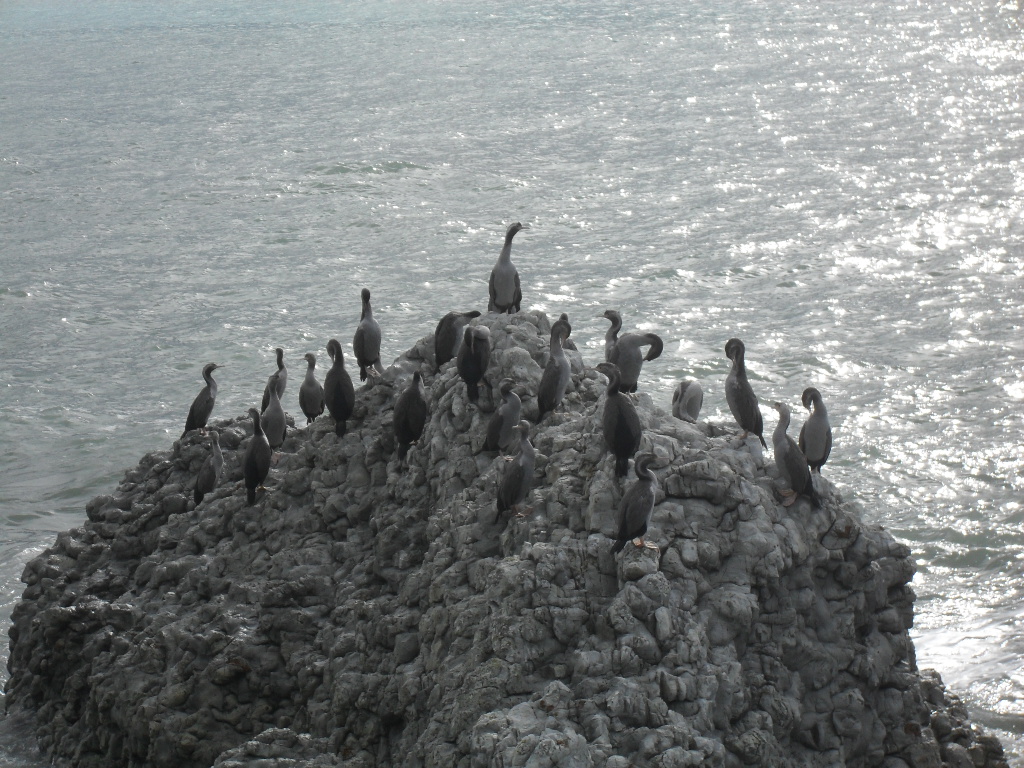
Despite living on an island, it had been a while since I'd seen the ocean, and I was eager to walk around the Kaikoura Peninsula. I was also lucky enough to do so on a sunny day. As I headed out along the peninsular road, the number of houses steadily dropped and the amount of wildlife increased. There is a well-advertised seal colony near the end of the peninsula, but before I was halfway there, I had already seen a colony of Hutton's shearwaters, a seabird that is endemic to New Zealand – in fact, endemic to the Kaikoura region. Once the town had been left behind a turn, I passed remnants of old whaling stations before reaching a boardwalk along the shore, leading to the seal colony. There had already been signs warning pedestrians to keep a safe distance from the seals, but I was surprised to find that the seals did not obey them. Had I not been on a boardwalk, I might have trodden on one as it lay in the bush along the shoreline.

The seal colony was the end of the road, so I continued on the trail which went up to the cliffs above, overlooking the ocean. Once again, I decided that I will need to create new words for “scenic,” because the view was staggering. Looking down from above on the clear water allowed me to get a sense of the ocean floor that I had read about, and gave me a view of a seal colony that is not advertised. I could see rain coming on, however, and did not stop to enjoy the view for too long.

The following morning, I hitched out of Kaikoura after a long walk to the edge of town, and made my way to Picton. I stayed there for the night and caught an early ferry to Wellington, where I stayed for five days, catching up with friends and running some errands. Before long, I was on a bus to Auckland, where I began my long series of flights back to the United States. 

Hanmer Springs.

The backdrop of Hanmer Springs.

Kaikoura, with the Kaikoura Ranges in the distance.

Hutton's shearwaters.

A seal, pondering a swim.

A seal, within the "safe distance."

Another seal colony, from above.

Looking south from the Kaikoura peninsula.

Friday, January 27, 2012

Meet the Neighbo(u)rs


The speed with which I moved to Arthur's Pass did not allow me to do much preparatory reading, something I always find useful when I travel. Other people's reactions to the news of my move were all I had to develop my expectations of the place, and none of them mentioned this area's most unique feature: the kea.

Kea are the world's only alpine parrot, doubtless a result of this country's unique geographical development. They are also endangered, having been seen as a danger to livestock in previous years. I am lucky enough to be in a place with lots of them, and they are certainly more interesting than most birds I've seen in Wellington or Central Otago.

But I'm not a birdwatcher. New Zealand is known for its wide variety of unique bird species, but I've only heard most of them. What makes kea unique is their behavior. Having evolved in a mountainous habitat with no mammals (all but one of New Zealand's mammals were introduced), kea have developed an inquisitive, fearless nature. The scarcity of food in the mountains means they must leave no stone unturned when feeding, and the lack of predators means they have little to fear in doing so. Wording it as such makes me sound like a biologist, but I borrowed that description from informational signs around town. For those not patient enough to read such signs, meeting the kea can be quite a surprise.

Some might consider the kea a pest. A coworker compares their mentality to that of a monkey (which makes me think of the winged monkeys in The Wizard of Oz). They tend to hang around the deck of our café and force customers to decide whether or not to obey the “don't feed the keas” signs attached to every table. And if the patrons do as the sign says, the kea frequently take it upon themselves to deprive people of sandwiches, fruit, or small snacks. But it isn't just food – remember, they are “inquisitive,” and have also been known to fly away with empty packaging, plates, car keys, and even passports. Before anyone starts thinking of a certain Alfred Hitchcock movie, be aware that none of their behavior is malicious: they have never been known to attack people, no matter what interesting possessions they might gain by doing so. But rather than “inquisitive and fearless,” some of our customers might say “annoying and shameless.”

The interaction between kea and tourist is always fun to watch. Being unique and brightly colored, kea attract attention just by being nearby. Most people, it seems, cannot imagine that such a beautiful animal would think of tearing out the rubber strip from a car's rearview mirror just to get a better look at it. When the kea begin doing exactly that, the reaction tends to be one of complete amazement rather than anger. The stories are endless: tourists distracted by a kea's antics, only to find that their food has been stolen as they turned to take photos; tour buses being delayed because a kea stole the keys; astonished yells of disbelief coming from the deck, where it is made quite clear that food will not be replaced if the birds take it. Although the tourists might be expected to react negatively to the kea in this area, many see the experience as special enough to warrant a photo. It is the kea's audaciousness (and endangered status) that keeps it safe: no one expects them to be so bold, and thus it is a special memory, rather than a special annoyance, when they reveal the full extent of their curiosity.

A kea hanging out on our deck. Not an unusual occurrence.


Kea at the top of Avalanche Peak.

As if it wasn't enough to remind us that they can fly up to a peak that took us hours to walk to, they try to take our lunches too!

A common reaction to a kea's presence. Hands on the camera means hands off the food, and a free lunch for a kea.

Wednesday, November 9, 2011

The End of The Beginning

As I have written previously, I tend to write less the longer I stay in one place. That's the only excuse I can offer for the gap between this post and my last. Especially with the end of the World Cup, things have started to become fairly routine here, within a broad definition.

In my view, major sporting tournaments are more fun at the beginning than at the end. There's still so much to come, and surprises can happen at any time. Furthermore, there are so many games being played that a boring game doesn't remain long in the memory. As the tournament progresses and the games become more pivotal, the remaining teams inevitably sacrifice creativity for reliability. Thus we get tight and suspenseful, but objectively unexciting play.

All this is to say that my excitement over the World Cup waned a little in the knockout stages, which began immediately after my last post. With games only on weekends, rugby had a much smaller presence in my life. That's not to say I didn't enjoy the quarterfinal weekend, which saw Wellington packed beyond belief with supporters and players from South Africa, Australia, Ireland, and Wales. Nor is it to say that France's 9-8 semifinal win over Wales didn't drive me absolutely insane with frustration. But the All Blacks' win over France in the final was, for me, more depressing for what it ended than exciting for what it achieved. It didn't help that the amount of pressure heaped on the men in black meant the win was more a source of relief than of ecstasy for Kiwis - although anyone on Wellington's Courtenay Place after the game finished might disagree.  

So now the opening act of my time in New Zealand is coming to a close, as I plan to pack up and move down to the South Island. The weeks since the close of the World Cup have been a bit of a blur - there have been a few pub quiz victories, my flatmates' final recitals (clarinet and viola), and a busy and entertaining work schedule. You can expect more frequent posting from me in the near future, as I'm heading to central Otago for the cherry harvest and should find plenty of new and exciting things to write about. But for now, here's a few photos of the past five weeks.
In the Te Kopahou reserve.

A sea lion, right along the waterfront.

People lining up for the All Blacks' victory parade. I had to work.

Genius advertising.

In Island Bay...summer's coming!

Tuesday, September 6, 2011

The Giddy Good Week That Was

Those of you who read this blog regularly may have noticed that I tend to publish less frequently after I've been in one place for a while. Things that were new and exciting become normal, and it becomes difficult to discern what is and is not interesting to people back home. I've gone over a week without writing anything, but this time it's not because of the onset of normalcy - in fact, it's exactly the opposite. The past week has been so full of new and exciting events that I haven't had time to tell you about them.

Last Monday was my day off, and I used it to go for a hike in some of the further reaches of Wellington's Town Belt, a series of nature reserves that surround the original city of Wellington. I walked south from my flat in Aro Valley to the suburb of Brooklyn along Ohiro and Happy Valley Roads. At Landfill Road - guess where it got its name - I turned off the road and took a footpath up to Hawkins Hill, one of the highest points in the area. The walk took me back to my time on the West Highland Way and the Kerry Way, and I kept marveling at the fact that this was all effectively in my backyard. At one point I looked east and realized that the next significant land mass in that direction was South America (apologies to the Pacific Islands). But none of the early parts of the walk prepared me for the sudden appearance of an ostrich less than ten feet from me. Fortunately, it was behind a fence (the path followed the boundary between the reserve and a private farm), but it was quite a shock. Ostriches don't look friendly, and they're gigantic. This one kept following me along the fence until it ran out of space, and then made the oddest call I've ever heard a bird make - some sort of barking sound in its throat. Needless to say, I was shaken out of the almost meditative state I'd been in as I walked by myself. The rest of my route took me past the Brooklyn wind turbine and down through some really dense forest before almost dropping me on my doorstep.

The rest of the week included some extra hours at work and my first trivia night victory after four tries. But the real highlight was Sunday night, when I happened to be in the same bar as the Welsh rugby team. While chatting with a group of friends, I looked up to see Andy Powell - one of my favorite rugby players - getting a tour of the pub, the only Welsh bar in the southern hemisphere. As with my sighting of Orlando Bloom, it took me a minute to convince myself that seeing Andy Powell was even a possibility. I knew that the Welsh had arrived in Wellington, and that their first match is here on Sunday, and when Powell's teammate Mike Phillips came in to join him, I was absolutely certain. I was starstruck, but the rest of the patrons hardly seemed to notice until the players left, when they received a hearty goodbye and best wishes. It was just another reminder of the fact that Wellington is the largest city I've ever lived in - not only was I in the same bar as the Welsh rugby team, but no one made a big deal out of it. It's a good thing I managed to recognize them, or this small-town boy would have missed out on quite a thrill!

Now that I've calmed down from that encounter, I can look forward to six weeks of world-class rugby. The world cup begins on Friday, and I've managed to obtain tickets via my flatmate Marcus - so when my fellow bar patrons take on South Africa on Sunday at Westpac Stadium, I'll be there. I'll try to keep you updated, but if I don't, you'll know why.

P.S. My camera battery died as I tried to take a picture of the ostrich, and I didn't have it when I saw Andy Powell, so...sorry.

The Beehive, New Zealand's Parliament Building. I walk past it every day.

In the hills above Wellington - the city is behind me, but you might not guess that.

Looking South over Cook Strait.

I'm pretty sure the next landmass in that direction is South America. You can't quite see it, but it's cloudy.

Bicycle polo in Aro Valley. Or hipsters on fixies, if you're jaded.

Wednesday, July 27, 2011

That Wasn't So Bad (Getting to New Zealand, parts 1 and 2)


As I sit at my gate in San Francisco International Airport, looking at a 747 that will soon take me to Auckland, I feel a bit rushed to review the past 9 days of travel before I get caught up in a new city, country, and hemisphere. But let's see how I do.


My previous post may have given you some idea about the train ride that my Dad and I took from Chicago to Richmond, CA. It was unlike any train ride I had ever taken. Although I had been on sleepers before, this was more like making the train my home for almost three days. Dad and I knew we were in for the long haul, so we settled in pretty quickly, beginning a best-of-3 series of rummy 500, making significant advances in our respective books, and learning the ropes of life on the train.


There were numerous delays in the schedule throughout the ride. This being Amtrak, we had expected the ones that affected our arrival time. What we had not expected were the struggles with mealtimes. Our meals were included in the ticket price, and the food was pretty high-quality for the circumstance. But it did get a bit frustrating to wait until 9.30 PM for your 8 PM dinner reservation to start. Fortunately, the food was worth waiting for and mealtime delays merely made the ride go by quicker by giving us something else to think about.


Not that we needed much else to think about once we reached the Rockies. Crossing the Midwest took a little less than 24 hours, and it was exactly as I expected - more corn and soybeans than you can imagine. We reached Denver just before noon on the second day, and from there, I entered a part of the United States that I had previously only seen in movies (Westerns, primarily). The Rockies were incredible, particularly the Colorado River. It seemed to be unable to decide what type of waterway it would be - a wide floodplain or a violent whitewater. About every 20 minutes, the train would enter a new gorge and the river would go the color of paper as it narrowed and the rocky bottom resisted its advance. At times, the waves appeared to move backwards. Soon, though, we would enter a wider valley in which the river became more like a lake with a current. Apparently the river is high this year, which made this whole process even more fun to watch. To top it all off, the train was mooned twice along this part of the route - once by a man balancing on a whitewater raft. A nice addition to the scenery, particularly during dinner time.


Utah passed mostly in the dark, but Nevada's desert was another sight unlike anything I've seen before. Although our route was flat, the scenery was far from boring. The mountains in the distance seemed to randomly change color and shape, and the scrub and sagebrush slowly degraded into salt flats, a phenomenon I would not have identified on my own (thanks, Dad). It was on this part of the ride that I saw a wild rabbit, the only wild mammal I would see in three days (mooners excluded).

Our final climb happened as we entered California near Lake Tahoe, and then we descended on a miniature version of our entire trip - scrubby desert, then farmland, and finally the industrial surroundings of San Francisco. 

Our time in the Bay area was fairly scattered - between the Napa Valley, San Jose, San Francisco, and Oakland, I feel like I've gotten a pretty good feel for the entire region. As scenic as it all is, I was overwhelmed by the amount of traffic, in which I was fortunately only a passenger. The sprawl also soured my introduction to California. For those of you already saying "Don't go to LA," don't worry, I'm not planning to. I did enjoy San Francisco, although I hadn't given it too much thought before my arrival. The hills were a bit trying at times, but the public transit is not only good, the operators are entertaining. I heard bus riders asked to "be like Moses and part so these people can get on," and operators yelling, "this is Ghirardelli square - if you want chocolate and ice cream, get off here." It's not worthy of live stand-up, but it was nice to have a little personality behind the wheel. San Francisco also includes historic trolley cars as part of their transit network, which is cool in so many ways. They've even been brought in from other cities that no longer use them, so you could ride a trolley car from Washington, St. Louis, Chicago, or Milan. Yes, that Milan, in Italy.


As usual, I made a point of trying the local culinary specialties. I particularly enjoyed the clam chowder in a bread bowl, which was as good as it is on the East coast. Our tour of Chinatown took us to a market with live seafood on sale (including frogs), but neither of us was brave enough to try any. It was entertaining enough to watch the delivery guy use a net to unload fish into the store's tanks. But the food could not top one of my favorite parts of San Francisco: the pier 39 sea lions.

San Francisco has been fun, but New Zealand has been at the back of my mind the entire time. As much as it's a great monkey to have on my back, I'll be happy when I finally arrive in Auckland.
Woke up at 3 AM to get a photo of the 4th of 6th new states that I visited.

The Pier 39 sea lions.

How do you know you're in the gay district? A Grease sing-along, that's how.

The plane I'll be boarding soon.

Saturday, June 11, 2011

Keeping Things Interesting

My week in Jaén with Pueblo Inglés came to an end yesterday when I returned to Logroño after 12 hours of traveling. Taken as a whole, the past week was easily the best seven days I've spent since I arrived in Spain in October. The people were interesting and friendly; the daily schedule was full but not overwhelming; the physical surroundings were beautiful; and, on a more practical note, the food was great. I can hardly think of a single moment that I did not enjoy. I've been telling people the program is a bit like a summer camp for adults, and people often make reference to the fact that children don't want summer camp to end - that was never true for me as a child, but it was this time. It would obviously be impossible to communicate exactly why that is, but here's a few highlights.

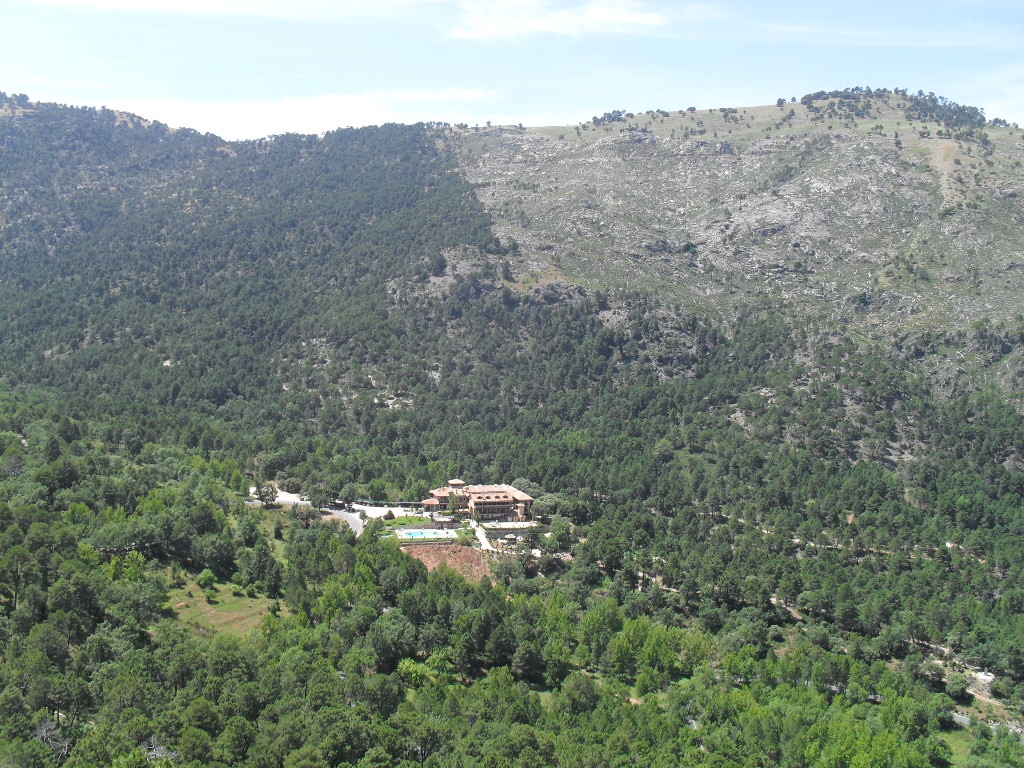
The program took place at a hotel near the town of Cazorla, a bit like a hunting lodge located in the Sierras de Cazorla national park. Our bus ride took us through acres of olive trees, which could only be expected, as 60% of Spain's olive oil is produced in the province of Jaén. The area around the hotel, however, was only mountains and forest. During one of our afternoon breaks, some other participants and myself took a hike to a nearby waterfall, where I indulged my love of wild swimming for the first time since last summer. I don't think I knew how much I had missed it until I dunked my head under a massive cascade of frigid water.

The majority of the week was built around speaking English in one-on-one sessions. Obviously this is intimidating for the students, but the English speakers also have to concern themselves with being able to maintain a conversation for almost an hour. For me, however, it was a relief to finally be working with adults. After 8 months of practically pulling teeth to make Spanish children speak English, speaking to Spanish adults was hardly more difficult than talking to a native English speaker for the same amount of time. My one-on-ones would often run over the allotted amount of time because of sheer interest. I don't think I've ever had so many interesting conversations or met so many interesting people in such a short space of time.

One of our mornings was also dedicated to an excursion into Cazorla, a city of about 8000 people. Some of the streets reminded me of Granada and took me back to my first visit to Andalucía two summers ago (also the reason I applied for this position). Although we didn't have long to explore, I was intrigued by the city's mountainous geography, waterways, and stray cats. Apparently my wandering ways caused me to miss an impromptu bullfighting demonstration by two of the group's members...can't win 'em all, I guess.

The idea of creating an English village means everything becomes part of the program, including the meals and free time. Naturally, that means the food has to be pretty good, and it was. Lunch and dinner were three-course meals, with the first and second dishes chosen from a menu the day before. The selections may have presented the greatest challenge for the English speakers, as many of them were quite unique to Spain and Jaén. One of the firsts was local wild game, a combination of boar and deer that left very little room for my second course. My experience with Spanish people this year led me to believe that the food would be a great conversation starter, and I was correct. With so many Spaniards from so many places, there were always opinions flying around the table (but not food, fortunately).

But the best part of this week was also the most intangible - the people. As I mentioned above, I have rarely met so many interesting people in such a short span of time, and it was absolutely fantastic to be around them. It would be impossible to fully explain why that was, so let's just leave it at this: put me in a group that includes a retired air force pilot, a circus performer, and an engineer/blogger/poet, and it sounds like the beginning of a joke. But it also allowed my curiosity to run wild and me to thoroughly enjoy myself.

Also, the hotel had a baby deer that was looked after by the staff and kept as a pet. As if the place wasn't awesome enough already.

The hotel and its surroundings.

Near the river I went swimming in - this waterfall was too far away, unfortunately.

Stray cats on a roof in Cazorla.

Bambi, the temporary pet of the hotel.

Sunday, February 13, 2011

Get Up! (Get on up)

The landscapes of this area are unlike any place I have ever lived in. Logroño is surrounded by mountains on all sides, although it doesn't feel as though we're very high up. The mountains earn that name by being steep, as many of them are little more than very large hills in my estimation. In any case, Eric, Megan, and I have done several hikes in the time we've spent here, but all them of originated in Logroño. Last Saturday, Eric and I finally managed to get out of the city and hike in the more formidable heights to the south.

Taking advantage of Logroño's 1.5-month-old metropolitan bus system, Eric and I rode to Albelda, one of the villages in which I work. Albelda is on a mountain, so walking through town is a hike in itself. The two of us strolled with no particular direction other than up. We quickly found ourselves in the midst of farmland, nearly bumping into donkeys and getting barked at almost incessantly by (well-restrained) guard dogs. The steepness of the mountain has led to some interesting developments, such as houses built into the mountain itself. Comparisons to hobbit holes are definitely appropriate. We found ourselves needing to avoid stepping on people's chimneys as we descended.

The views were probably the best part of the whole experience, as we were actually in the steep mountain range that divides Logroño from the southern part of La Rioja. While we were still able to see Logroño and other mountains that we've climbed, we were able to see the southern range in much greater detail than we ever had. The brilliant sun, and the sight of snow at the higher altitudes, only improved the experience. And yes, I have pictures.

The view that greets me every morning I arrive in Albelda.

Note donkey on the left. There was another above who was more camera-shy.

Can you say "Spaghetti Western?"

One smiley, happy hiker.
Bodegas built into the mountainside.

Not to sound like an ad, but there's a completely different La Rioja up above.


Our hike was brief, but every minute brought many hours' worth of enjoyment. As we got on the bus to go home, we spotted a local man riding a donkey through town. We were, regrettably, unable to grab a photo, but it was hard to tell what was funnier - that this man was riding through town on a donkey, or that nobody else seemed to notice or care.

One week later, Megan joined Eric and I for another hike along the Rio Iregua, which I cross every day on my way to work. My camera battery decided to die before I could take any photos of that hike, but I did manage to wade through the (very shallow) river. It's a poor substitute for the swimming hole I'd like to find, but it was still refreshing and chilly.

More adventures to come, stay tuned. You can read Eric's account of the same hike and our dinner that night on his blog here. He's a much better photographer.