Showing posts with label farm work. Show all posts

Sunday, January 15, 2012

After the Gold Rush

After the events of my previous post, I returned to Alexandra to begin a job as a cherry picker. Since then, things have been fairly uncertain, so I figured I would wait for some concrete developments before posting anything (a lifetime of supporting the Boston Red Sox has taught me not to tempt fate).


I had originally not planned to do any farm work during January, as Kiwi students on summer holidays would make competition for jobs even steeper. But during my time thinning apples in Roxburgh, I heard about the "red gold" that is Central Otago's cherries (oddly enough, an area with a history of gold mining). So I lined up a job in Alexandra and showed up for my first day on January 4. About one hour into the day, I was asked to pick apricots instead of cherries. Happy just to have a job, I accepted. But there's a reason they don't refer to apricots as "orange gold."

Apricot harvesting is more difficult than cherry harvesting, as you carry more weight at a time and receive less money per bag. Pickers are guaranteed more work because apricots are hardier than cherries, but the work is much more intense than thinning was. While thinning, I was generally left alone to work and received two or three visits per day from my supervisors. Picking requires everybody to work in the same area so as to fill bins (about 30 bags' worth of apricots) more quickly, and the supervisor is an almost constant presence. Harvesting is more time-sensitive than thinning, and the pressure to get the job done quickly passes all the way down from the orchard managers to the pickers. Pickers, being the bottom rung of the ladder, hear constant complaints about the color, size, and firmness of the fruit they pick. And even if every bag is perfect, there will be good fruit left on the trees that must be removed, and of course, constant pressure to earn minimum wage (if you're not earning minimum, the orchard is forced to top up your pay and gets fewer apricots from you). I found earning minimum very challenging, meaning I did not feel very secure in my position. It was also discouraging to watch a group of 20 pickers dwindle to about 8 in less than a week. When I realized how far I'd wavered from my original plan for the month of January (not only was I doing farm work, I wasn't even doing the farm work I'd hoped to do), I decided to move on.

Luckily, right when that occurred to me, Central Otago received its first serious rain since I've been here (late November). That gave me two days off to plan, and a quick job search found a café in Arthur's Pass looking for a general kitchen hand. In a reminder of why I love New Zealand so much, I sent off a fairly speculative job application, which got me a reply by phone within an hour. Within two hours of sending the application via email, I had a new job.

Arthur's Pass is a small village on the train route between Greymouth and Christchurch, in the heart of the Southern Alps. The train that passes through it is considered one of the most beautiful train rides in the world, and tourism continues throughout the year (the scenery is better in the winter). Although this job will prevent me from seeing Southland during the summer, it will hopefully allow me some stability over the next few months. As I need to renew my passport, having a consistent address will be useful. And as much as I enjoy the simplicity and exercise of seasonal farm work, I've had much better experiences working in cafés.

Spending 9 hours per day picking apricots doesn't leave much time for photography. But a couple coworkers and I found a creative way to release the stress and frustration of hearing "too green!" every time we dropped a new bag. See below.


Friday, December 23, 2011

6,063 words (or its equivalent in photos)

My job thinning apples finished on Thursday, and now I'm spending Christmas weekend in Wanaka, a little resort town north of Queenstown. It remains to be seen what I'll be doing next, but it will probably involve harvesting cherries somewhere in Central Otago.

I feel as though I've been relying too much on verbal descriptions lately, so here's 6,000 words worth of photos.

Waiting for the bus to work at 7.30 in the morning.

My last row of apple trees to thin (on the left).

The view from the top of the ladder.

Wanaka.

Lake Wanaka.

The only snow I'll see this Christmas.

Thursday, December 15, 2011

Peon's Progress


Rain has kept me out of the orchard for the second time this week, so I thought a general update on life in Roxburgh might be in order. Apple thinning is going well. Although we get paid by the tree and I do not move particularly quickly, we are guaranteed minimum wage and we work plenty of hours per week, so I've made a tidy sum already. The first week was a challenge, but since then my body has adjusted to the schedule. Seasonal work has a reputation for being physically demanding, but apple thinning has to be among the least so. You're not required to carry anything apart from the ladder, and your speed depends more on hand-eye coordination and dexterity than on muscle strength. I was skeptical about my fitness for the first few days, but now I'm planning to stay in Central Otago through January for the cherry harvest, which is apparently quite lucrative.

Apart from the massive quantity of working holidaymakers I've met here, there is a group of workers from Vanuatu who come here annually for the same reason. Much like Caribbean workers in Niagara's vineyards, these guys have specific seasonal work visas that allow them to work from November to April. They work an exhausting schedule, but they joined in a big game of soccer last Sunday (everybody's day off). It was fun listening to them talk, as their language mixes in intelligible pieces of English, Spanish, and French. When they asked for a substitute, they would say something like, “Wanagum? Wanagumplay?” I also heard quite a few double syllables, a trait that Pacific languages seem to share (Maōri does it too). The sound “bilim bilim” came up frequently, though I'm not sure what it means. It was a nice treat to interact with them, because we working holidaymakers speak of the “Vanuatus” as the standard for excellence in seasonal labor. They work from 7-5:30 for 6 days, and rumors of their speed are always making their way around the hostel. Naturally this means we have little chance to talk with them, since they're always working, cooking, or sleeping – unless it's Sunday.

My current job ends next week, so the Christmas holidays will play host to my next little adventure – Wanaka. I had numerous ideas about my first Christmas away from my family, but Wanaka comes well-recommended from my coworkers. It's not as touristy or as busy as Queenstown, but it is gaining a reputation for its New Year's festivities. I'll be staying there for a while, but there's plenty to do in Wanaka – it's on the shores of Lake Wanaka, close to Mount Aspiring National Park, and developing a range of high-adrenaline activities in the shadow of New Zealand's adventure capital, Queenstown. This will also be my first time in the Southern Alps, the mountain range that runs the length of the South Island. Limiting myself to Wanaka rather than visiting Southland (my other idea) will also allow me to get back to Central Otago fairly quickly after the holidays, increasing my chances of landing a job harvesting cherries. 

Downtown Roxburgh. Don't blink.

Playing the gee-tar down by the Clutha river.


Saturday, December 3, 2011

Workin' in the Fields 'til you get your back burned, workin' in the fields 'til you get your facts learned...


With one week of apple thinning behind me, many of my questions about seasonal work have been answered. And I can confidently say that this foray into farm labor has not been a mistake. I found a job almost by accident on my first day of searching in Alexandra, and began work the next day in Roxburgh. The ease of finding full-time work is one major benefit of seasonal employment – hospitality jobs in Wellington were almost always for part-time or casual employees.

I began working within 24 hours of finding the job, after moving from Alexandra to Roxburgh and settling in for an early wakeup the next morning. We spent the first morning filling out pre-employment forms and signing a contract, then began thinning under the supervision of our foreman, a very friendly and understanding guy. Most of my coworkers are internationals like me, with a few Kiwi students there for the summer (I'm still getting used to December being the summer). The largest groups seem to be Germans, Czechs, and South Americans – primarily Argentinian, with a few Uruguayans and Chileans in the mix. The first thing our foreman said was, “how is everybody's English?”

Since then, it has been 40 hours of the most repetitive work I've ever done. Thinning simply means reducing the fruit on the trees to allow the remaining apples to grow to full size. It is amazing how many discussions can be had about various thinning techniques, but none of them seems to eliminate the problem of sore thumbs. Much like the callouses built by playing guitar, however, the thumbs eventually toughen up and now I hardly notice as I thin 60 small trees per day. My coworkers spend much of the day with headphones on, but I prefer to let my mind wander, which can hardly be avoided when doing such mundane work.

Once I overcame the initial hurdles of changing my routine and building a thumb callous, I've come to my own set of conclusions about seasonal farm work. Many people arrive with illusions of working hard and making tons of money, but the prices per tree are designed so that workers make minimum wage. My biggest frustration has been the lack of transparency about the prices, which is such that I may have done 50 trees before learning their price. I even worked a full day unaware that the price of the trees I was thinning had dropped because we were working too quickly. However, the law guarantees us minimum wage every day, and the long hours mean I will certainly be able to save some money no matter how fast I am (they also ensure that I have little energy to spend money elsewhere). I had also been concerned about the intensity of the job, something everyone mentions. It's lucky I'm doing thinning rather than harvesting, as it requires no lifting. While certainly physical labor, I return from work in a gratified state of fatigue, rather than in serious pain. Sleeping has never been so easy.

There's one more hurdle I've had to overcome – being surrounded by fellow travellers. Although I spent plenty of time with foreigners in Wellington, many of them were English speakers, and I spent at least 50% of my time with Kiwis. Seasonal farm labor, logically, seems to attract non-native speakers of English, as it doesn't require them to speak it. It has been quite a change to be in the minority as a native speaker of English, and to hear New Zealand spoken of as a place to visit rather than as a place to live. In the end, of course, I am just a visitor, but I've always preferred to live abroad, rather than just be abroad. I can dream, can't I?

This job lasts for another three weeks, and I'm still formulating plans for Christmas and New Year's. More than likely, they will not involve being anywhere with a tree and presents, and certainly not with snow. Regrettably, I have not taken any photos of my new job, but I can promise you, it looks much better than the inside of an office.

Thursday, December 1, 2011

The Edinburgh of the South


This now week-long journey on the South Island was always meant to end in Central Otago for the fruit harvest, where I am now. I did remain in Dunedin for a few days, however, and it had plenty to offer. The presence of the University of Otago means Dunedin bears some resemblance to Kingston, ON (where I went to university) – many of the houses in the downtown area are undeniably student houses, and most cafés provide wireless internet for free. But while Kingston gets overshadowed by Ottawa and Toronto, Dunedin is one of the major cities in New Zealand and thus feels less exclusively like a university town. When I stopped by the tourist office to pick up a map, it was full to bursting with cruise ship passengers and Elton John fans (he performed on Friday). And although I did stop by the university, it was less a destination than a place to wander.

One thing I definitely wanted to see in Dunedin was the Speight's brewery. Being in a country so far from all others, most of the beer here is uniquely Kiwi, but Speight's is probably the most likely to be recognized overseas thanks to its long-running Southern Man ad campaign (for Neil Young fans, that's someone from southern New Zealand, not the U.S.). Being such an iconic brand – and such a tasty beer – I almost felt obligated to take the tour. The Speight's brewery is one of the few remaining gravity-operated breweries in the world, meaning its raw materials are delivered to the top floor and the finished product comes out at the bottom. They also still use wooden vats in the fermentation process, the only remaining brewery in the world to do so. Their location was chosen based on the presence of a spring, which not only makes the beer but is also diverted to a tap on the street and made available to the public. But of course the best part of any brewery tour is the tasting. Although Speight's limits its guests to 30 minutes, they do allow you to pour your own (in fact, they require you to), and they play the Southern Man ad campaign as you do so. If I was designing a brewery tour, I could hardly do better than they have – I believe I owe the folks at Speight's a “good on ya, mate.”

As I wandered around Dunedin, Central Otago was always in the back of my mind. I made sure to buy a new pair of shoes for outdoor work, as well as a rain cover for my pack. I haven't done any farm work yet, but I do know one thing – trying to plan for it in advance is immensely frustrating. Everybody I've spoken to has given me contradictory advice, and potential employers do not seem to hire in advance (for fairly logical reasons). I had long since decided that the solution was simply to be physically present in a region with jobs available, and I was right. I left Dunedin on Sunday afternoon and checked in at Alexandra Backpackers, which was luckily having its cherry season kickoff barbecue as I arrived. I heard even more conflicting reports from other travellers – some had work already, but the general consensus was that because the cherry harvest hasn't yet begun, jobs are hard to come by. Expecting a bit of a wait to find work in Alexandra, I made my way to a seasonal work agency this morning to hopefully make some sense of the situation. Typically of my experience with this job hunt, I was led to believe that there were very few jobs available, and that not having my own transportation would make it much more difficult to find work. I was ready to return to the hostel and settle in for a long stay when I was informed of a job opportunity in Roxburgh, just down the highway. I suppose it makes sense that such a frustrating job search would end so unexpectedly, but at least now I'm employed. And despite the confusion, I have once again managed to turn a vague shadow of a plan into reality, as I did in Wellington. The other foot has yet to drop in New Zealand. 

From the top of Baldwin St, steepest in the world.

In the Speight's brewery.

The tap from Speight's spring - free to everyone.

The Clutha River in Alexandra, where I stayed my first night in Central Otago.

Wednesday, November 23, 2011

Southbound


After the beauty of Picton and Marlborough Sound, I was reminded how visually stunning this country is and made a minor alteration to my schedule. Rather than take the bus to Christchurch, I took one of New Zealand's three passenger train routes. The price was markedly higher, but the thrill of taking a train never gets old for me. Furthermore, I saw the size of the hills around Picton and I wasn't sure I wanted to risk motion sickness for the second consecutive day after the ferry ride on Monday. So I awoke early enough to wander around Picton for a few hours – it's hard to get lost there – and booked a train ticket to Christchurch for the early afternoon.

The train ride, once again, forces me to use the word “beautiful” or “stunning.” I'm going to have to invent new words to describe New Zealand, because there are only so many adjectives in the English language that refer to natural beauty. In any case, the ride took us past the township of Blenheim (Blen-um, not Blen-heim) and along the Pacific coast to Kaikoura. All of these places are names I recognize from stories other travellers have told me, but nothing compares to seeing them in person. Kaikoura is known for its aquatic wildlife, so whale-watching and swimming with dolphins are both popular activities, and seal colonies line the train route just north of town. It also lies at the foot of panoramic, snow-capped hills that make it a live postcard.

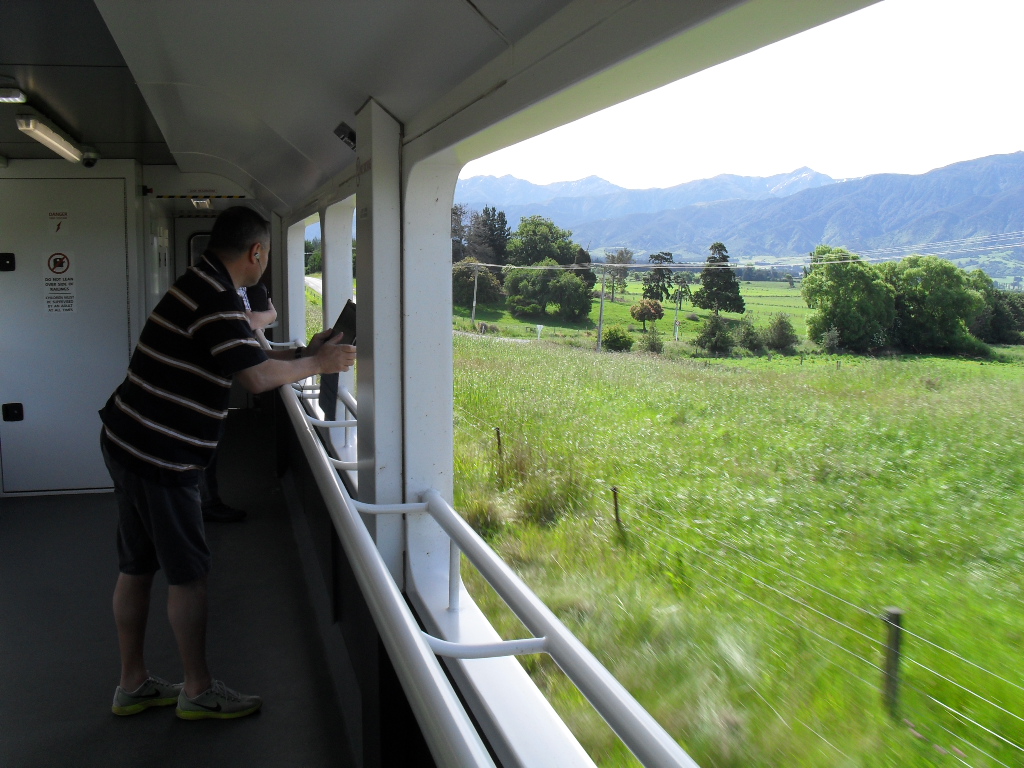
But I was not staying in Kaikoura, and the remainder of the trip was no less enjoyable to watch fly by the window. This train even had an outdoor viewing car, something I'd never experienced before. A honeymooning American couple sat across from me after Kaikoura, and our conversation made me feel like a long-term New Zealand resident – not a bad feeling at all. Hopefully I made their vacation a little more enjoyable.

My stay in Christchurch was brief but pleasant. I did not manage to see the earthquake-damaged city center because I was busy enjoying the hospitality of my former flatmate Marcus and his family. His father took me on a quick tour of the University of Canterbury and the CBS arena, the only remaining large audience venue in the city. Christchurch is an extremely flat and well-landscaped city (it's nicknamed the Garden City), quite different from the hills and natural reserves of Wellington. I wasn't able to form a very detailed impression, however, because I was quickly hopping on a bus to Dunedin to take me closer to my destination of Central Otago's farms and vineyards.

The bus ride passed through Canterbury's southern plains, which are the only large flat areas in the entire country, I believe. There were always hills visible in the distance, however, and south of Timaru the route began to rise and fall gently (much more gently than the Interislander). All manner of livestock were munching away at the grass as we passed: sheep were the most prevalent, of course, but there were plenty of cows and quite a few deer. When I was young, seeing a deer by the side of the road was a cause for excitement because wild deer are known for being skittish. In New Zealand, the deer are all domesticated, and it continues to baffle me.

I arrived in Dunedin in the midst of a downpour, but my friend Bernie's dad met me rather quickly and before long I was at dinner with his entire family (except Bernie, who's in Wellington). As much as I like to avoid generalization, I think it's fair to say that Kiwis are a pretty hospitable bunch. I'm now planning to stay in Dunedin until the weekend and head out to Alexandra on Sunday, hopefully to find a job harvesting fruit.

Remember how I said I'd write more often once I left Wellington? 

At the railway station in Kaikoura.

The outdoor viewing car - I wanted to see this guy to drop his iPad over the edge so badly.

The most significant earthquake damage I saw in Christchurch.

Wednesday, November 9, 2011

The End of The Beginning

As I have written previously, I tend to write less the longer I stay in one place. That's the only excuse I can offer for the gap between this post and my last. Especially with the end of the World Cup, things have started to become fairly routine here, within a broad definition.

In my view, major sporting tournaments are more fun at the beginning than at the end. There's still so much to come, and surprises can happen at any time. Furthermore, there are so many games being played that a boring game doesn't remain long in the memory. As the tournament progresses and the games become more pivotal, the remaining teams inevitably sacrifice creativity for reliability. Thus we get tight and suspenseful, but objectively unexciting play.

All this is to say that my excitement over the World Cup waned a little in the knockout stages, which began immediately after my last post. With games only on weekends, rugby had a much smaller presence in my life. That's not to say I didn't enjoy the quarterfinal weekend, which saw Wellington packed beyond belief with supporters and players from South Africa, Australia, Ireland, and Wales. Nor is it to say that France's 9-8 semifinal win over Wales didn't drive me absolutely insane with frustration. But the All Blacks' win over France in the final was, for me, more depressing for what it ended than exciting for what it achieved. It didn't help that the amount of pressure heaped on the men in black meant the win was more a source of relief than of ecstasy for Kiwis - although anyone on Wellington's Courtenay Place after the game finished might disagree.  

So now the opening act of my time in New Zealand is coming to a close, as I plan to pack up and move down to the South Island. The weeks since the close of the World Cup have been a bit of a blur - there have been a few pub quiz victories, my flatmates' final recitals (clarinet and viola), and a busy and entertaining work schedule. You can expect more frequent posting from me in the near future, as I'm heading to central Otago for the cherry harvest and should find plenty of new and exciting things to write about. But for now, here's a few photos of the past five weeks.
In the Te Kopahou reserve.

A sea lion, right along the waterfront.

People lining up for the All Blacks' victory parade. I had to work.

Genius advertising.

In Island Bay...summer's coming!